
Employability of MBA Graduates in 2026: Why They Are Second Most In-Demand After Engineers
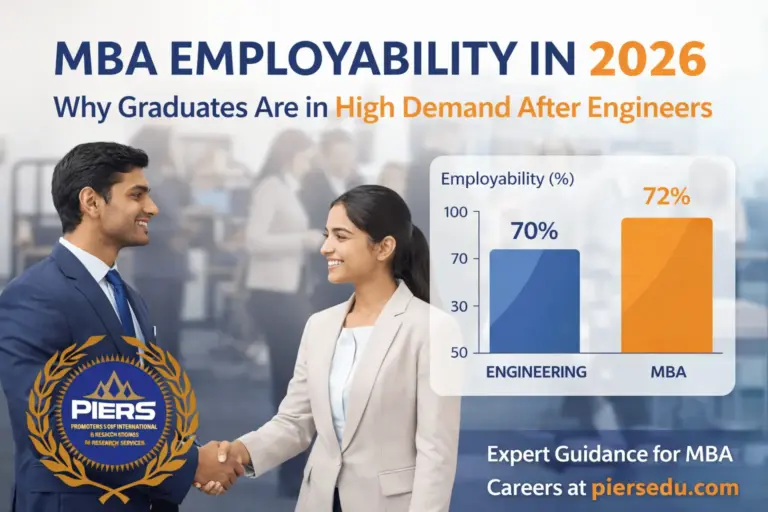
In the dynamic job market of 2026, companies are not just looking for technical skills — they want strategic thinkers who can lead teams, solve complex business problems, and adapt in a fast-changing environment. And that’s exactly why MBA graduates remain among the most employable professionals, second only to engineers.
Let’s explore the latest trends, backed with statistics and real campus placement insights from India’s leading management institutes.
📊 1. MBA Employability Trends: 2019–2026
According to the India Skills Report series, MBA employability has seen remarkable growth over the past few years, even outpacing many traditional degrees:
| Year | MBA Employability (%) | Engineering (B.Tech) (%) |
|---|---|---|
| 2019 | 36.44 | 57.09 |
| 2020 | 54.00 | 49.00 |
| 2023 | 60.10 | 57.44 |
| 2025 | 78.00 | 71.50 |
| 2026 | 72.76 (approx) | 70.15 (approx) |
📌 Data shows MBA employability reached around 78% in 2025, higher than engineering — but in 2026 it stabilized slightly below engineers’ strong technical demand. Still, MBAs remain very close behind engineers.
What does this tell us?
✔ MBA employability isn’t just a trend — it’s now a core pillar of India’s graduate job market.
✔ Even if MBAs dip slightly in 2026, their demand remains consistently strong because companies need managerial talent.
📌 2. Why MBA Graduates Are in Demand (Even After Engineers)
a) Business Needs Are Growing Beyond Technical Roles
Engineers are essential for building products and technology, but businesses of all sizes — from startups to large corporations — also need professionals who can:
Lead teams
Develop business strategy
Manage operations and finance
Translate technical work into business outcomes
This puts MBAs right behind engineers in the employability rankings.
b) Shift Toward Hybrid Skills
Today’s employers don’t just want management theory — they want MBAs who understand:
Data analytics
Digital strategy
AI-driven business models
Tech-enabled operations
This skill blend makes MBA graduates highly adaptable and versatile.
📈 3. Campus Placement Insights: Real Numbers from Top B-Schools
Want proof of MBA demand from the ground level? Here are recent campus placement highlights from 2025–26:
🌟 Top Institutes — Exceptional Outcomes
IIM Nagpur (Batch 2023–25):
– 100% placements
– Highest CTC: ₹69.57 LPA
– Average CTC: ~₹18.07 LPAUniversity Business School (UBS), Panjab University:
– 85% placement rate
– Top package: ₹25.11 LPA
– Average CTC ~₹12.95 LPATop IIMs (Ahmedabad, Bangalore, Calcutta):
– Nearly 100% placement participation
– Average CTC: ₹30–35 LPA (varies by campus)
– Highest packages can exceed ₹1 crore PA in elite rolesNMIMS Mumbai:
– Average CTC: ₹25.13 LPA
– Highest CTC: ₹67.70 LPA (MBA Core)
📌 These figures show that companies are still willing to pay premium salaries for MBA talent, especially in consulting, finance, analytics, and strategy.
📊 4. Placement Chart Snapshot: MBA vs Engineering Salaries
Here’s a simplified chart based on recent placement trends from Deloitte Campus Workforce Trends and campus reports:
| Category | Median Salary (2025) |
|---|---|
| MBA (Top 10 Colleges) | ~₹26 LPA |
| Engineering (Top 10 Colleges) | ~₹17 LPA |
💡 MBA graduates, particularly from top business schools, often receive higher median salaries than engineers at top tech colleges — reflecting strong corporate demand.
🧠 5. What Employers Are Looking For in 2026
It’s no longer enough to just have an MBA degree.
Modern employers want:
✔ Tech literacy: Understanding data, analytics, and digital transformation
✔ Leadership skills: People management and strategic thinking
✔ Domain expertise: Finance, operations, marketing analytics
✔ Problem solving: Ability to drive results in real business contexts
This is why MBA programs that include skill-based learning, internships, and hands-on business projects are outperforming traditional lecture-based degrees.
📉 6. Challenges Facing MBAs in 2026
Despite strong demand, MBA employability is slightly declining in 2026 according to major reports — not due to lack of skill, but because:
🔹 Employers increasingly favour specialized or hybrid candidates (e.g., MBA + analytics or tech)
🔹 Generalist MBAs may struggle without digital or domain skills
🔹 AI and automation are reshaping business functions
👉 Bottom line: MBAs must continuously upgrade their skill set to stay competitive.
🏆 Final Verdict: MBA Is Still a Strong Career Investment in 2026
Even if engineers remain the most employable in 2026, MBA graduates are not far behind — they are still among the top hiring priorities for companies across sectors.
Here’s why:
✅ Strong career growth opportunities
✅ Strategic and leadership roles
✅ High salaries, especially at top campuses
✅ Key roles in consulting, finance, and analytics
MBA remains a powerful launchpad — not just for corporate jobs but for entrepreneurship, consulting, and innovation.
🚀 Ready to Build a High-Employability MBA Career in 2026?
Understanding market trends is just the first step. The real success lies in making the right academic and career decisions at the right time.
That’s where piersedu.com becomes your trusted partner.
At piersedu.com, students get:
✔ Expert guidance on MBA college selection (India & abroad)
✔ Career-oriented advice based on current employability trends
✔ Support for admissions, counseling, and career planning
✔ Insights into high-demand MBA specializations for 2026 and beyond
Whether you are a final-year student, a working professional planning an MBA, or someone confused about career direction, piersedu.com helps you choose not just a degree — but a future with strong employability.