
How Many Colleges Should You Fill in NEET UG 2026 Counselling? A Complete Choice Filling Strategy for Maximum MBBS Admission Chances
Scoring high on the NEET UG 2026 examination is a monumental achievement, but it represents only half the journey toward wearing the white coat. The final, critical determinant of where you will pursue your medical education begins during NEET UG 2026 Counselling.
Every academic year, thousands of qualified medical aspirants with commendable All India Ranks (AIR) miss out on securing an MBBS seat in top-tier government medical colleges—not because their scores were insufficient, but because they committed avoidable errors during the choice filling and locking process. Conversely, candidates with moderate ranks frequently secure seats in well-established government medical colleges simply because they executed a data-backed, mathematically sound choice filling preference list.
One of the most pressing questions asked by aspirants and parents alike is: “How many colleges should I fill in my preference list on the MCC portal?” Is there an upper cap? Should you list 10, 50, 150, or every available college in India?
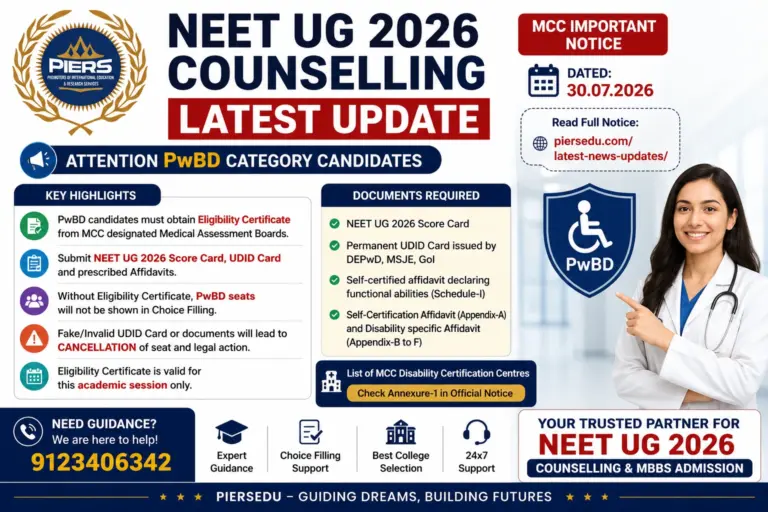
This guide breaks down the exact mechanics of the Medical Counselling Committee (MCC) software algorithm, details rank-based choice counts, outlines a 3-tier preference strategy, and incorporates the latest official NMC & MCC Guidelines for PwBD Candidates (Released July 30, 2026).
1. The Core Answer: How Many Colleges Should You Fill?
You should fill as many eligible medical colleges as possible—ideally every institution where you are genuinely prepared to study.
There is no upper limit on the number of choices you can submit on the official MCC portal (mcc.nic.in) or state counselling portals. Whether you select 20 options or 350 options, the registration and security deposit fees remain identical.
The Golden Rule of NEET Choice Filling:
There is zero strategic or financial penalty for maintaining a longer preference list; there is only severe, irreversible regret if your list runs out before the seat allotment algorithm reaches your rank.
                     +-----------------------------------+
                     |   MCC Choice Filling Algorithm    |
                     +-----------------------------------+
                                       |
                                       v
                   +---------------------------------------+
                   | Evaluates Choice #1 at Candidate Rank |
                   +---------------------------------------+
                                       |
                     +-----------------+-----------------+
                     |                                   |
            [Seat Available]                    [Seat Full]
                     |                                   |
                     v                                   v
           +--------------------+               +------------------+
           | ALLOT SEAT & STOP! |               | Evaluate Choice  |
           | (Lower choices     |               | #2 at Rank       |
           |  are ignored)      |               +------------------+
           +--------------------+                        |
                                                  [Repeat Downward...]
2. Understanding the MCC Seat Allotment Algorithm
To understand why listing additional colleges can never harm your admission chances, you must understand how the Medical Counselling Committee’s automated seat processing algorithm operates:
Strict Merit Hierarchy: The software processes candidates strictly in order of their All India Rank (AIR) within their respective category (UR, OBC-NCL, SC, ST, EWS, PwBD).
Sequential Top-to-Bottom Evaluation: When the system reaches your AIR, it evaluates your Choice #1. If an open seat exists in Choice #1 for your category, it immediately grants you that seat and ceases further scanning of your list.
Cascading Safety Mechanism: If Choice #1 is filled by higher-ranked candidates, the software seamlessly transitions to Choice #2, then Choice #3, and so on down your submitted preference list.
Lower Choices Remain Inactive: Choices listed below your allotted college are never evaluated or processed. Placing a “safe” college at Position 60 will never prevent you from securing your dream college listed at Position 1.
3. Case Study: The Danger of Under-Filling Your Choice List
Consider how choice list length impacts two hypothetical candidates holding identical ranks in the All India Quota (AIQ) round:
| Parameter | Candidate A (Under-Filer) | Candidate B (Strategic Filer) |
| All India Rank (AIR) | AIR 18,500 (General / UR) | AIR 18,500 (General / UR) |
| Total Choices Submitted | 12 Colleges (Only top state GMCs) | 145 Colleges (Tiered List) |
| Algorithm Evaluation Outcome | Choices #1 through #12 filled up at AIR 17,900. System ran out of choices. | Choices #1 through #42 filled up. System allotted Choice #43 (A solid peripheral GMC). |
| Round 1 Result | NO SEAT ALLOTTED | SEAT ALLOTTED |
| Strategic Advantage | Holds no seat; exposed to cutoff shifts in Round 2. | Holds a guaranteed seat; eligible for Round 2 Upgradation. |
Candidate A made the mistake of assuming cutoffs from previous years would remain completely static. Candidate B secured a safety net while keeping the door open for upward mobility.
4. Recommended Choice Count by NEET Rank Tiers
While the general rule is to maximize choice entries, the minimum recommended choice count varies across candidate rank brackets:
  AIR Spectrum          Recommended Minimum Choices      Primary Strategic Focus
  ========================================================================================
  AIR 1 - 5,000         15 - 30 Colleges                 Top Premier Institutions & AIIMS
  AIR 5,000 - 15,000    40 - 85 Colleges                 Established Regional GMCs
  AIR 15,000 - 25,000   120 - 200+ Colleges              Complete Coverage of AIQ GMCs
  AIR 25,000+           All Eligible Colleges            GMCs, Category Seats, Deemed/Private
Tier A: Top Performers (AIR 1 to 5,000)
Target Institutions: AIIMS New Delhi, JIPMER Puducherry, MAMC New Delhi, VMMC & Safdarjung Hospital, KGMU Lucknow, and top state government colleges.
Recommended Number of Choices: 15 to 30 colleges.
Key Considerations: Focus on clinical exposure, internal PG quota benefits (e.g., Delhi University / IP University quotas), and department infrastructure.
Tier B: High-Score Zone (AIR 5,000 to 15,000)
Target Institutions: Established state government medical colleges across North, South, East, and West India.
Recommended Number of Choices: 40 to 85 colleges.
Key Considerations: Balance geographical preferences, hospital bed capacity, patient inflow, and state service bond commitments.
Tier C: Borderline Government Seat Zone (AIR 15,000 to 25,000)
Target Institutions: Peripheral and newly established government medical colleges across all states.
Recommended Number of Choices: 120 to 200+ colleges (Select ALL eligible AIQ Government Medical Colleges).
Key Considerations: High cutoff volatility exists here. Do not omit colleges in distant states or newly commissioned GMCs.
Tier D: Self-Financed & Quota Range (AIR 25,000 and Above)
Target Institutions: State Quota seats (for reserved categories), Deemed Universities, Private Medical Colleges, and Management Quota options.
Recommended Number of Choices: As many as financially viable.
Key Considerations: Tuition fee structures, mandatory bank guarantees, hidden charges, and operational hospital infrastructure.
5. The 3-Tier “Safety Pyramid” Choice Filling Architecture
Never arrange your choice list randomly or copy lists from social media. Structure your list using the 3-Tier Safety Pyramid Architecture:
                /\
               /  \       TIER 1: REACH / DREAM (Top 15-20%)
              /    \      Colleges above last year's cutoff rank
             /------\
            /        \    TIER 2: TARGET / REALISTIC (Middle 50-60%)
           /          \   Colleges closely matching your AIR range
          /------------\
         /              \ TIER 3: SAFE / BACKUP (Bottom 20-30%)
        /________________\ Colleges comfortably below your AIR range
Tier 1: Dream / Reach Choices (Top 15–20% of List)
Definition: Premier institutions where last year’s closing rank was slightly better than your current rank.
Purpose: Ensures that if cutoffs drop or new seats are added, you don’t miss out on a higher-ranked college.
Example: At AIR 10,000, place colleges that closed at AIR 6,000 to 9,500 at the very top.
Tier 2: Target / Realistic Choices (Middle 50–60% of List)
Definition: Core choices where previous closing ranks align directly with your rank.
Purpose: Represents your most probable seat allotment window.
Example: At AIR 10,000, list colleges that closed between AIR 9,500 and 13,000.
Tier 3: Safe / Backup Choices (Bottom 20–30% of List)
Definition: Colleges where previous closing ranks fell significantly below your current rank.
Purpose: Acts as a safety net against unexpected rank shifts or sudden surges in candidate competition.
6. Official Update: MCC Notice & NMC Guidelines for PwBD Candidates (Counselling 2026)
On July 30, 2026, the Directorate General of Health Services (DGHS) and the Medical Counselling Committee (MCC) released an urgent official notice (Ref. U-11011/07/2026-MEC) regarding updated guidelines from the National Medical Commission (NMC). These guidelines govern candidates applying under the Persons with Benchmark Disabilities (PwBD) quota for NEET UG 2026.
+-----------------------------------------------------------------------------------+
|               NMC & MCC PwBD EVALUATION WORKFLOW (NEET UG 2026)                   |
+-----------------------------------------------------------------------------------+
                                          |
                                          v
                +---------------------------------------------------+
                | Candidate Obtains Permanent UDID Card (DEPwD)     |
                +---------------------------------------------------+
                                          |
                                          v
                +---------------------------------------------------+
                | Submits Self-Certified Affidavit (Appendices A-F) |
                +---------------------------------------------------+
                                          |
                                          v
                +---------------------------------------------------+
                | Visits 1 of 61 Designated MCC Assessment Boards   |
                +---------------------------------------------------+
                                          |
                                          v
                +---------------------------------------------------+
                | Functional Competency Evaluation (CBME Standard)  |
                +---------------------------------------------------+
                                          |
                        +-----------------+-----------------+
                        |                                   |
              [Functional & Safe]                    [Ineligible]
                        |                                   |
                        v                                   v
             +--------------------+               +-------------------+
             | ELIGIBILITY        |               | SPEAKING ORDER    |
             | CERTIFICATE ISSUED |               | RECORDED (NMC)    |
             +--------------------+               +-------------------+
                        |                                   |
                        v                                   v
             +--------------------+               +-------------------+
             | PwBD Choices Shown |               | Appeal to DGHS    |
             | on MCC Portal      |               | Appellate Board   |
             +--------------------+               +-------------------+
Key Highlights of the NMC PwBD Guidelines 2026:
Shift from Numerical Disability to Functional Competency: The NMC framework (notified by Secretary Dr. Raghav Langer on 27/07/2026) moves away from relying solely on disability percentage percentages. Admission eligibility is determined by evaluating whether the candidate can perform essential competencies under the Competency Based Medical Education (CBME) curriculum, with or without reasonable accommodations.
Expansion of Assessment Centers: To improve accessibility, MCC/DGHS expanded designated assessment centers from 16 to 61 Medical Assessment Boards across India.
Mandatory Documentation for Eligibility Certificate Generation: PwBD candidates must present the following documents at one of the 61 designated centers:
NEET UG 2026 Score Card.
Permanent UDID Card issued by the Department of Empowerment of Persons with Disabilities (DEPwD).
Self-Certified Affidavits: Schedule-I / Appendix-A (General Self-Certification) along with disability-specific affidavits (Appendix-B for Hearing Impairment, Appendix-C for Upper Limb Locomotor, Appendix-D for Lower Limb Locomotor, Appendix-E for Mental Illness/SLD/ASD, Appendix-F for Visual Disability).
Three Possible Assessment Outcomes: The Medical Assessment Board evaluates candidates and issues an Eligibility Certificate classifying them as:
Eligible: Meets all functional requirements without requiring special modifications.
Eligible with Reasonable Accommodation: Capable of completing MBBS with specified assistive technology, digital accessibility tools, or ergonomic modifications.
Ineligible: Declared only if the candidate cannot acquire essential CBME competencies despite reasonable accommodations, or if patient safety is demonstrably compromised. Ineligibility requires a Reasoned Speaking Order.
Portal Integration: Only candidates who secure an Eligibility Certificate from a designated MCC assessment center will have PwBD reservation seats displayed on their choice-filling portal.
Right to Appeal: Candidates aggrieved by the Medical Board’s decision can appeal to the designated Appellate Authority under DGHS within the notified timeframe.
7. Major Designated Medical Assessment Boards (Annexure-1)
Candidates claiming PwBD seats can visit any of the 61 designated centers across the country. A selection of major centers includes:
| State / Union Territory | Designated Assessment Center | Disabilities Evaluated |
| New Delhi | Vardhman Mahavir Medical College & Safdarjung Hospital (VMMC) | All disabilities except Visual, Intellectual & Behavioral. |
| New Delhi | ABVIMS & RML Hospital | All disabilities except ENT (Visual LVA allowed). |
| New Delhi | Lady Hardinge Medical College (LHMC) | All specified disabilities. |
| Maharashtra | Grant Government Medical College & JJ Hospital (Mumbai) | All specified disabilities. |
| Maharashtra | AIIPMR (Mumbai) | Locomotor Disabilities only. |
| Maharashtra | Ali Yavar Jung National Institute (Mumbai) | Speech and Hearing Disabilities only. |
| West Bengal | IPGMER (Kolkata) | All specified disabilities. |
| Tamil Nadu | Madras Medical College (MMC Chennai) | All specified disabilities. |
| Karnataka | AIISH (Mysuru) | Speech & Hearing Disabilities only. |
| Karnataka | BMCRI (Bengaluru) | All specified disabilities. |
| Uttar Pradesh | KGMU (Lucknow) / IMS BHU (Varanasi) | All specified disabilities. |
| Rajasthan | SMS Medical College (Jaipur) | All specified disabilities (with testing restrictions). |
| Bihar | PMCH / NMCH / IGIMS (Patna) | All specified disabilities. |
8. Five Critical Factors to Evaluate Before Listing a College
Before placing any medical college on your preference list, evaluate these key operational parameters:
| Evaluation Criteria | Key Details to Verify | Why It Matters |
| Hospital OPD & Clinical Exposure | Average daily Outpatient Department (OPD) volume and bed occupancy rate. | Higher patient flow ensures better practical learning and surgical exposure during clinical postings. |
| Compulsory Rural Service Bond | State-mandated service duration (1 to 5 years) and financial penalty amounts. | A steep bond obligation can restrict immediate post-MBBS PG preparation. |
| State PG Institutional Quota | Availability of 50% internal state quota seats for postgraduate (MD/MS) admissions. | Completing MBBS in states with larger PG seat pools offers long-term advantages. |
| Complete Annual Fee Breakdown | Tuition fees, hostel charges, security deposits, and annual inflation clauses. | Prevents financial strain, especially in Deemed Universities and Private colleges. |
| Geographical Location & Language | Regional language, local weather conditions, and transport connectivity. | Language barriers can impact history-taking during clinical ward rotations. |
9. Common Choice Filling Blunders to Avoid
Steer clear of these common mistakes during the counselling window:
Placing “Safe” Colleges at Choice #1: Placing a lower-tier college at Position 1 out of caution. If allotted, lower choices are locked out completely, depriving you of better options.
Confusing AIR with Category Ranks: Analyzing previous General category cutoffs when competing under OBC-NCL, SC, ST, EWS, or PwBD quotas. Always cross-check category-specific cutoff ranks.
Saving Without Final Locking: Assuming that saving choices submits them. While saved choices auto-lock at the deadline, manually locking and downloading the locked choice PDF ensures peace of mind.
Including Unwanted Filler Options: Adding colleges you would refuse to join. Allocations in Round 2 or Mop-Up/Stray rounds can lead to forfeiture of security deposits if rejected.
Filling Preferences on Mobile Devices: Mobile browsers can suffer layout shifts or drag-and-drop glitches. Always use a desktop or laptop browser for choice filling.
10. Step-by-Step Choice Filling Process on the MCC Portal
Visit mcc.nic.in, click on “UG Medical Counselling”, and enter your Roll Number and Password.
Browse available options in the master list based on your category and seat quota.
Move selected colleges to your preference list and arrange them from highest preference (Position 1) downward.
Click “Save & Continue” regularly during editing sessions.
Lock choices using OTP authentication during the locking window and download your locked choice summary.
11. Frequently Asked Questions (FAQs)
Q1. Is there an extra fee for filling more choices in NEET counselling?
No. The registration fee and security deposit paid to MCC or state authorities cover unlimited choice entries.
Q2. What happens if I do not lock my choices manually before the deadline?
If you have saved your choices, the MCC system will automatically lock your last saved preference order upon deadline expiration. However, manual locking is strongly encouraged to verify your final ordering.
Q3. Can I modify my choice preference list in Round 2?
Yes. MCC allows fresh choice submission and reordering for all participating candidates in Round 2. Your Round 1 choice list does not carry over automatically.
Q4. Should borderline candidates include BDS or AYUSH courses?
If your goal is strictly MBBS, do not include BDS or AYUSH courses. If allotted a seat in a course you do not want, rejecting it can impact your counselling standing.
Q5. Where do PwBD candidates get their functional eligibility evaluated?
PwBD candidates must obtain an Eligibility Certificate by visiting one of the 61 designated Medical Assessment Boards listed in MCC Annexure-1 with their UDID card and required self-certification affidavits.
Summary Checklist for NEET UG 2026 Choice Filling
[x] No Choice Cap: Add every college you are open to joining.
[x] Structure Your List: Use the 3-Tier Safety Pyramid (Dream, Target, Safe).
[x] Use Category Data: Review cutoffs based on your specific category.
[x] Evaluate Fine Print: Check bond durations, penalties, and fee schedules.
[x] PwBD Requirements: Obtain your Eligibility Certificate from an official MCC center if claiming PwBD reservation.
[x] Desktop Editing: Submit choices on a desktop computer, save regularly, and print your locked choices slip.
Need Help with NEET UG 2026 Counselling?
 Contact PIERS EDU – Expert MBBS Counselling
Confused about NEET UG 2026 State Counselling, MBBS college selection, document verification, or choice filling? Our experienced counsellors are here to help you make informed admission decisions.
PIERS EDU (OPC) Pvt. Ltd. Jagarnath Tower, 3rd Floor, Circular Road, Lalpur, Ranchi – 834001, Jharkhand
 Phone/WhatsApp: +91 91234 06342
 Email: info@piersedu.com
 Website: www.piersedu.com
We Help You With:
 NEET UG 2026 State Counselling
- AIQ & State Quota Guidance
- MBBS, BDS & BAMS College Selection
- Choice Filling & Locking
- Document Verification Support
- Category & EWS Certificate Guidance
- Seat Allotment Strategy
- Round 1, Round 2, Mop-Up & Stray Vacancy Counselling
Book your personalized counselling today and maximize your chances of getting the best possible medical college based on your NEET UG 2026 rank.
 Instagram
 Facebook
 Twitter