
MBBS Seats Increased, But Why Is NEET Competition Still So High in 2026?
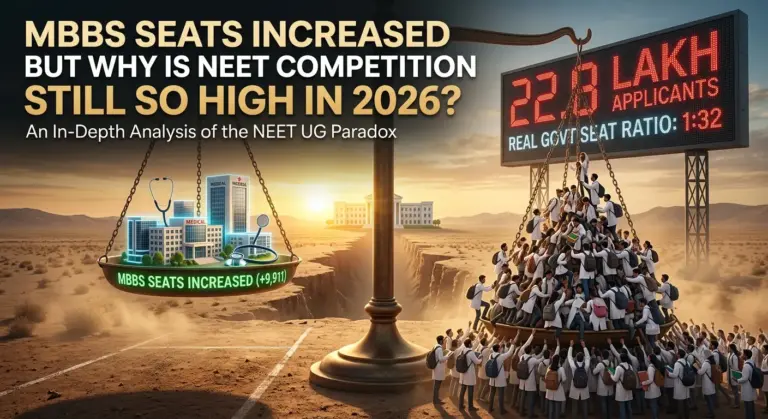
Over the last few years, official press releases from the Ministry of Health and the National Medical Commission (NMC) have routinely highlighted significant growth in medical education infrastructure. For the 2026–27 academic session, India added 9,911 new MBBS seats, pushing the nation’s total to an unprecedented 1,36,939 undergraduate medical seats across 823 colleges.
On paper, an extra 10,000 seats ought to offer relief to medical aspirants. Yet, the reality on the ground tells a very different story:
The cutoff score required to secure a seat in a Government Medical College (GMC) continues to climb.
A score of 600 out of 720—once considered a golden ticket to a top state medical college—no longer guarantees a government seat in high-competition states.
The psychological pressure on candidates and parents remains at an all-time high.
Why does increasing capacity fail to dilute the competition? Why is getting into a government medical college in 2026 just as grueling—if not more so—than it was five years ago?
This deep-dive analysis unpacks the mathematical, financial, structural, and socio-economic factors driving the NEET 2026 Paradox.
1. The 2026 NEET UG Reality: Key Statistics at a Glance
To understand the intense competition, we must first examine the actual numbers released by the National Testing Agency (NTA) and the National Medical Commission (NMC) for 2026.
Table 1: NEET UG 2026 Core Data Breakdown
| Metric | 2026 Official Figures | What It Means |
| Total Registered Candidates | ~22.8 Lakhs (22,79,743) | A massive candidate pool competing nationwide. |
| Total Appeared Candidates | ~20.0 Lakhs (19,99,895) | ~87.7% attendance rate. |
| Qualified Candidates | 11.21 Lakhs (11,21,185) | Candidates meeting minimum percentile thresholds. |
| Total MBBS Seats | 1,36,939 seats | The total capacity across government and private sectors. |
| Government MBBS Seats | 63,296 seats | The affordable seats that 95% of candidates target. |
| Private & Deemed Seats | 73,643 seats | High-fee seats out of reach for most families. |
| Newly Added Seats in 2026 | 9,911 seats | Net expansion in intake capacity. |
The True Candidate-to-Seat Ratio
While news headlines state that India has nearly 1.37 lakh MBBS seats for 22.8 lakh candidates (~16 candidates per seat), this overall ratio creates a false sense of security.
When you isolate Government Medical College (GMC) seats—which are the primary focus for middle-class Indian families—the real ratio changes drastically:
This means nearly 32 candidates compete for every single government MBBS seat. Furthermore, after factoring in category reservations (OBC, SC, ST, EWS, PwD), the seat availability for General Category (Unreserved) candidates in government colleges drops to under 25,000 seats nationwide.
2. Factor 1: The Government vs. Private Seat Divide (The Financial Barrier)
The single biggest reason seat increases haven’t eased competition is where those new seats are located.
Of the 1,36,939 total MBBS seats in 2026:
46.2% (63,296) are in Government Colleges.
53.8% (73,643) are in Private Colleges and Deemed Universities.
Out of the 9,911 seats added in 2026, over 7,800 seats were added in private medical colleges, while government colleges received only around 2,111 additional seats.
The Financial Disparity
┌────────────────────────────────────────────────────────────────────────┐
│                        THE COST DIVIDE IN 2026                         │
├───────────────────────────────────┬────────────────────────────────────┤
│     GOVERNMENT MEDICAL COLLEGES   │      PRIVATE / DEEMED UNIVERSITIES  │
├───────────────────────────────────┼────────────────────────────────────┤
│ Tuition: ₹10,000 to ₹1.5 Lakh/yr  │ Tuition: ₹12 Lakh to ₹28 Lakh/yr   │
│ Total Degree Cost: ₹1 Lakh - ₹8 L │ Total Degree Cost: ₹60 L - ₹1.5 Cr │
│ Accessible to: All income groups  │ Accessible to: Top 3-5% financially│
└───────────────────────────────────┴────────────────────────────────────┘
For the vast majority of Indian households, spending ₹70 Lakhs to ₹1.5 Crore for an undergraduate medical degree is not financially viable. Consequently, 90% to 95% of all NEET qualified candidates compete exclusively for the 63,296 government seats.
Adding thousands of private seats provides relief primarily to affluent families, while competition for affordable government seats remains intense.
3. Factor 2: The Multi-Year Dropper / Repeater Accumulation Effect
In engineering exams like JEE Advanced, strict limits are placed on the number of attempts. NEET UG, however, currently has no upper age limit and no cap on the number of attempts.
This policy design has created a multi-year compounding effect:
Year 1 (Fresh Class 12 Students): ~9 to 10 lakh students take NEET while managing board exams.
Year 2 (1st Year Droppers): ~8 to 9 lakh students dedicate 100% of their time solely to NEET preparation.
Year 3+ (2nd & 3rd Year Droppers): ~3 to 4 lakh seasoned retakers who have already revised the NCERT syllabus multiple times.
Why Retakers Drive Up Cutoffs
A student taking a drop year focuses entirely on test-taking strategies, speed, and identifying trick questions, without the distraction of board examinations.
Data Insight: In the top 10,000 rank list for NEET 2026, multi-year retakers continue to represent a significant share of high scorers. When thousands of students spend 2 to 3 years mastering a fixed 97-chapter syllabus, average scores rise sharply, driving up the cutoff required for admission.
4. Factor 3: Democratization of Quality Prep via EdTech
A decade ago, top-tier NEET coaching was concentrated in hub cities like Kota, Delhi, Hyderabad, and Sikar. Access required significant financial investment for classroom fees and hostel living expenses.
The rapid growth of affordable online education platforms, low-cost internet access, and structured digital test series has altered this landscape:
Equal Access to Quality Content: A student in a tier-3 town or rural area can now access high-quality video lectures, chapter-wise question banks, and daily mock tests for a fraction of traditional coaching costs.
Early Preparation Culture: Foundation courses starting as early as Class 8 or 9 have become commonplace, allowing students to cover the Class 11 and 12 NCERT syllabus well before their peers.
High-Volume Mock Testing: Modern online platforms provide instant analytics, rank predictors, and error notebooks, helping students systematically eliminate weaknesses.
Because high-quality preparation is now accessible nationwide, student performance across all regions has improved significantly.
5. Factor 4: Predictable Paper Patterns & NCERT Saturation
Since the NTA took over conducting NEET, the exam pattern has aligned closely with the line-by-line NCERT textbooks for Biology, Physics, and Chemistry.
While a predictable exam pattern ensures fairness, it also introduces specific challenges:
1. The Saturation Effect
When an exam sticks strictly to a single textbook set over multiple years, top aspirants memorize nearly every definition, diagram, and summary note.
2. High Accuracy Requirements
Because the paper structure is familiar, top students regularly achieve high accuracy rates. The difference between a 650 score and a 680 score often comes down to just 6 or 7 questions.
3. Rank Volatility in High Score Bands
In NEET 2026, a single incorrect response can cause a student’s rank to drop by hundreds or even thousands of places.
NEET 2026 Score Compression:
Score: 715/720 ───► Rank ~1 to 2 (Joint Toppers)
Score: 700/720 ───► Rank ~Top 20
Score: 650/720 ───► Rank ~1,400+
Score: 600/720 ───► Rank ~10,000+
When thousands of candidates score above 600, even a significant seat increase fails to lower the cutoff rank needed for top colleges.
6. Factor 5: The “Doctor Tag” & Lack of Equivalent Alternatives
In India’s socio-economic landscape, medicine remains one of the most respected and stable professions. This cultural perception creates an asymmetric demand curve.
                  ┌─────────────────────────────────────────┐
                  │   22.8 Lakh NEET Registered Applicants  │
                  └────────────────────┬────────────────────┘
                                       │
                ┌──────────────────────┴──────────────────────┐
                ▼                                             ▼
  ┌───────────────────────────┐                 ┌───────────────────────────┐
  │   Target A: MBBS Degrees  │                 │ Target B: Alternative Path│
  │   (First Choice for ~95%) │                 │ (BDS, BAMS, BHMS, BPT)    │
  └─────────────┬─────────────┘                 └─────────────┬─────────────┘
                │                                             │
                ▼                                             ▼
  ┌───────────────────────────┐                 ┌───────────────────────────┐
  │ Extreme Competition &     │                 │ High Vacancy Rates &      │
  │ Multi-Year Retakes        │                 │ Unfilled Counselling Seats│
  └───────────────────────────┘                 └───────────────────────────┘
Why Allied Fields Face Low Preference
Although fields like Dental Surgery (BDS), Ayurvedic Medicine (BAMS), Homeopathy (BHMS), Veterinary Science (BVSc), Physiotherapy (BPT), and Biotechnology offer viable career paths, they are often viewed purely as backup options.
Many candidates scoring 550–580 choose to drop another year to pursue an MBBS seat rather than enrolling in BDS or BAMS. This dynamic returns tens of thousands of high-scoring candidates back into the applicant pool every year.
7. State-Wise Competition Matrix & Quota Realities
NEET UG counselling operates under a dual-quota structure:
All India Quota (AIQ – 15%): Managed by the Medical Counselling Committee (MCC) for seats across all government colleges nationwide.
State Quota (85%): Reserved exclusively for state domicile candidates and managed by respective state authorities.
Because seat availability and candidate density vary widely by state, competition levels differ significantly across the country.
Table 2: Top States by MBBS Seats vs Competition Intensity (2026 Data)
| State | Total MBBS Seats | Govt Seats Share | Domicile Competition Level |
| Karnataka | 15,395 seats | Moderate (~45%) | Balanced (High total seat count) |
| Uttar Pradesh | 14,000 seats | Balanced (~48%) | Extremely High (3.5L+ candidates) |
| Tamil Nadu | 13,999 seats | High (~60%) | High (Fierce state reservation competition) |
| Maharashtra | 13,099 seats | Balanced (~46%) | Extremely High (2.2L+ candidates) |
| Rajasthan | 8,080 seats | Moderate (~40%) | Fiercest Cutoffs in India (High-scoring pool) |
| Delhi (NCR) | ~1,500 seats | High GMC share | Highest AIQ/State Cutoff (Top tier score density) |
In high-competition states like Rajasthan, Delhi, Uttar Pradesh, and Bihar, state quota cutoffs often exceed All India Quota cutoffs. A candidate in Rajasthan might miss out on a state government seat with a 630 score, whereas a candidate with the same score in a state with more seats relative to applicants might easily secure admission.
8. Strategic Roadmap for NEET Aspirants (2027 & Beyond)
Given these structural realities, candidates preparing for upcoming NEET exams need a clear, realistic preparation strategy.
1. Shift Target Metrics from Marks to Ranks
Focusing solely on a target score (e.g., “I need 600 marks”) can be misleading due to year-on-year score inflation. Instead, aim for an All India Rank (AIR) within the top 20,000 to secure a government MBBS seat comfortably under general categories.
2. Prioritize NCERT Mastery
Biology: Treat NCERT line-by-line, including diagrams, tables, footnotes, and introductory pages.
Chemistry: Focus on NCERT examples, in-text questions, and reaction mechanisms for Organic and Inorganic sections.
Physics: Ensure strong conceptual clarity, master formula applications, and solve past 15-year NEET and JEE Main introductory physics problems.
3. Develop a Negative Marking Minimization Strategy
At high score levels, unforced errors often dictate outcomes.
A candidate who attempts 160 questions with 100% accuracy scores 640 marks. A candidate who attempts all 180 questions with 25 errors scores 595 marks. Minimizing negative marks is critical for maintaining rank position.
4. Create an Informed Alternative Path
Establish a clear timeline and decision framework:
Decide in advance the maximum number of drop years you are willing to take (e.g., 1 or 2 years maximum).
Research viable alternatives early, such as BDS, BVSc, BAMS, Allied Health Sciences, B.Tech Biotechnology, or foreign medical universities recognized by the NMC.
9. Frequently Asked Questions (FAQs)
Q1: How many total MBBS seats are available in India in 2026?
As per the latest NMC seat matrix for the 2026–27 academic session, India has 1,36,939 UG MBBS seats across 823 medical colleges. This includes 63,296 government seats and 73,643 private/deemed seats.
Q2: Why is a 600 score no longer a guarantee for a Government Medical College?
Due to score compression and high performance among retakers, thousands of candidates now score above 600. Because there are only ~63,296 total government seats nationwide (and under 25,000 for open/unreserved candidates), the rank corresponding to a 600 score often falls outside the selection range in high-demand states.
Q3: How many students appeared for NEET UG 2026?
Approximately 22.8 lakh candidates registered and nearly 20 lakh candidates appeared for the NEET UG exam in 2026.
Q4: Will adding more medical colleges solve the competition problem?
While adding new colleges gradually improves overall capacity, it does not immediately lower cutoffs. Candidate registrations continue to grow by 1 to 2 lakhs annually, and the accumulation of retakers keeps performance levels high.
Q5: What is the difference between All India Quota (AIQ) and State Quota?
15% of all government medical college seats across India are pooled into the All India Quota (AIQ), open to candidates from any state. The remaining 85% of seats are reserved for candidates who fulfill the respective state’s domicile criteria.
10. Key Takeaways
┌─────────────────────────────────────────────────────────────────────────┐
│                     THE NEET 2026 REALITY CHECK                         │
├─────────────────────────────────────────────────────────────────────────┤
│ 1. SEAT QUALITY MATTERS: Over 50% of seats are private with high fees.  │
│    The real competition is for the ~63,296 government seats.            │
│                                                                         │
│ 2. DEMOCRATIZED PREP: Online learning has raised average preparation   │
│    standards nationwide, driving up score requirements.                 │
│                                                                         │
│ 3. THE RETAKER FACTOR: Multi-year droppers raise the benchmark score   │
│    for fresh Class 12 applicants.                                       │
│                                                                         │
│ 4. STRATEGY IS KEY: Focus on rank positioning, NCERT accuracy, and     │
│    minimizing negative marks rather than tracking raw scores alone.     │
└─────────────────────────────────────────────────────────────────────────┘
While adding ~10,000 MBBS seats in 2026 is a positive development for India’s healthcare infrastructure, it does not automatically make entering medical school easier. Aspiring doctors must navigate this environment with clear expectations, disciplined preparation focused on accuracy, and a practical long-term career plan.
Need Help with NEET UG 2026 Counselling?
📞 Contact PIERS EDU – Expert MBBS Counselling
Confused about NEET UG 2026 State Counselling, MBBS college selection, document verification, or choice filling? Our experienced counsellors are here to help you make informed admission decisions.
PIERS EDU (OPC) Pvt. Ltd.
📍 Jagarnath Tower, 3rd Floor, Circular Road, Lalpur, Ranchi – 834001, Jharkhand
📱 Phone/WhatsApp: +91 91234 06342
📧 Email: info@piersedu.com
🌐 Website: www.piersedu.com
We Help You With:
- ✅ NEET UG 2026 State Counselling
- ✅ AIQ & State Quota Guidance
- ✅ MBBS, BDS & BAMS College Selection
- ✅ Choice Filling & Locking
- ✅ Document Verification Support
- ✅ Category & EWS Certificate Guidance
- ✅ Seat Allotment Strategy
- ✅ Round 1, Round 2, Mop-Up & Stray Vacancy Counselling
Book your personalized counselling today and maximize your chances of getting the best possible medical college based on your NEET UG 2026 rank.
 Instagram
 Facebook
 Twitter